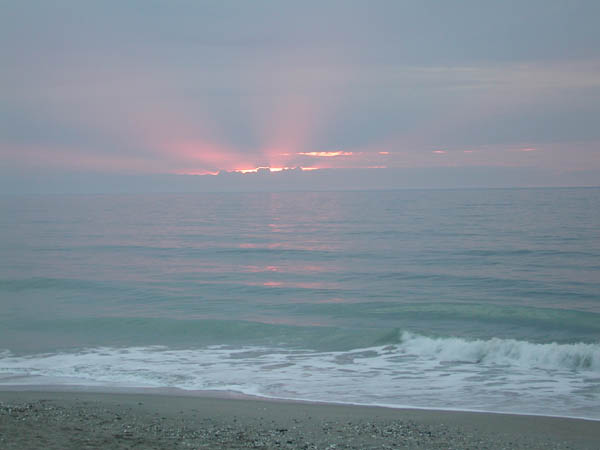
The gorgeous sunrise set the tone for the day.
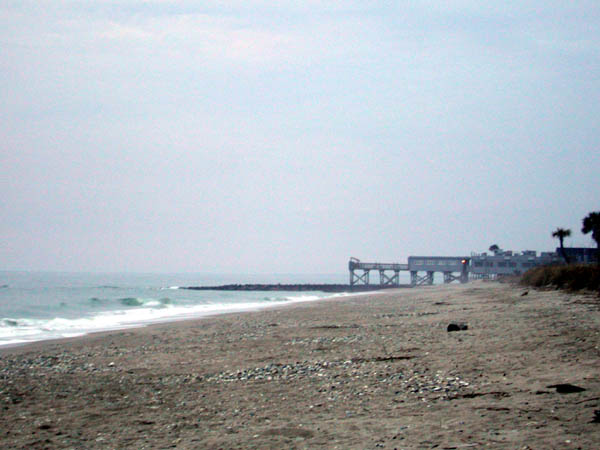
Profile view of the beach.
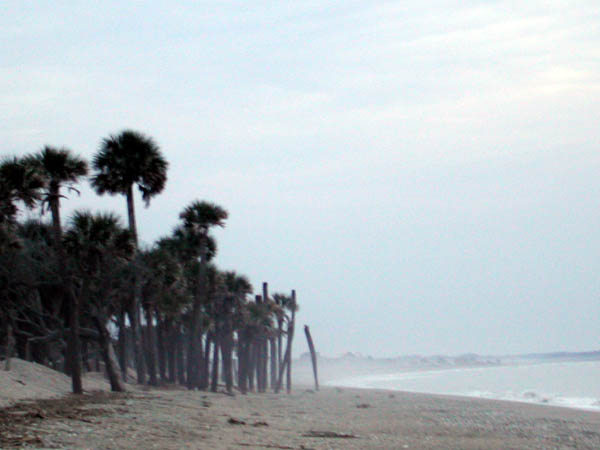
Palmetto trees provide evidence for the beach retreating.
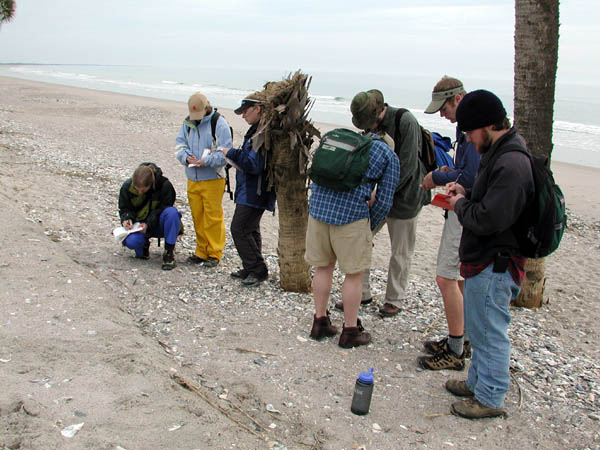
Recording in our notebooks…always an engrossing activity!
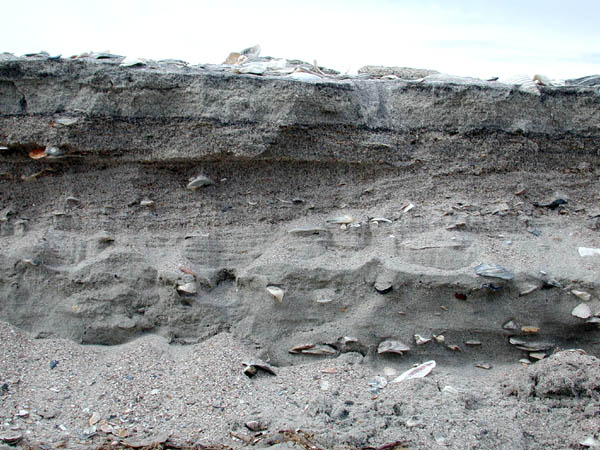
An eroded dune.
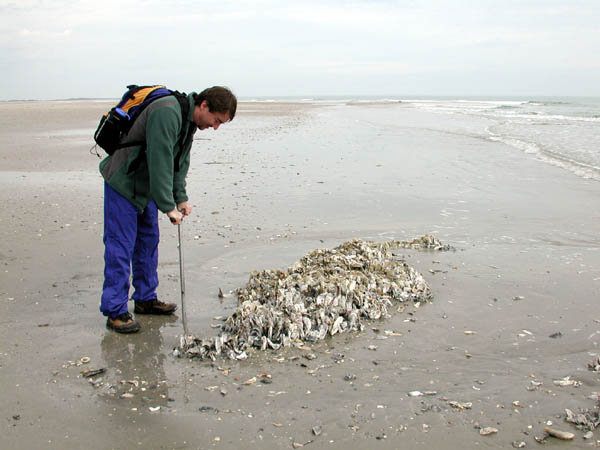
Get that core!
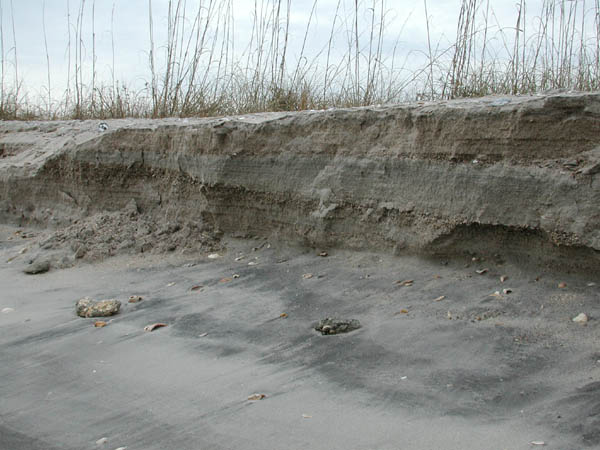
Cross bedding in the dune structures.
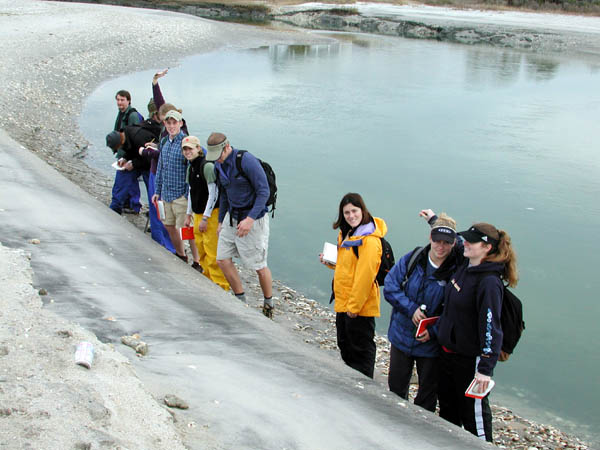
Sharing the cross bedding with friends…priceless!
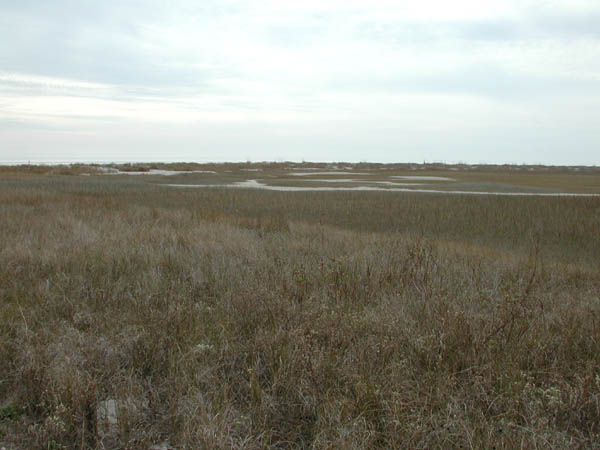
The view of washover fans in the marsh.
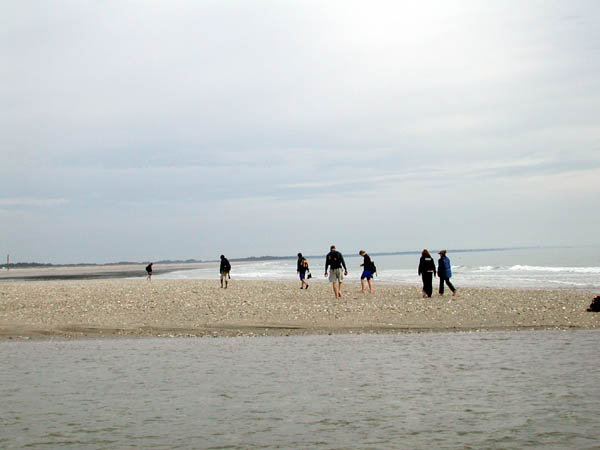
Tidal Delta…and the hunt for shark teeth!
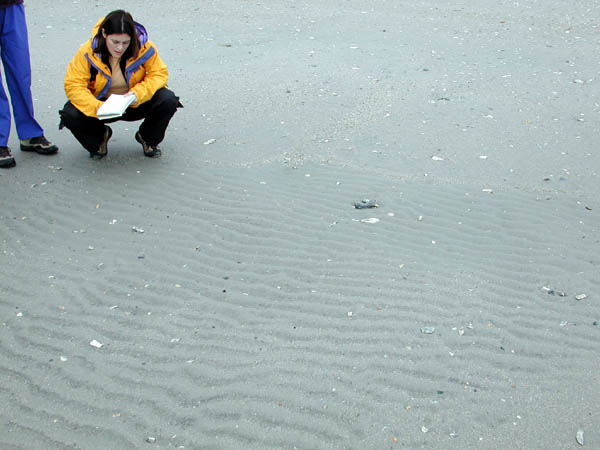
Kristy engrossed in the ripples!
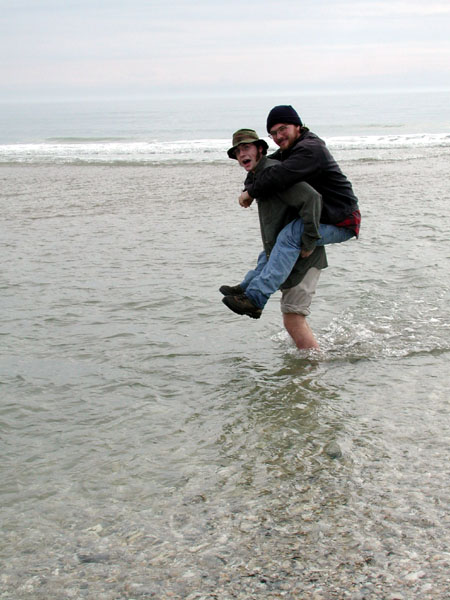
Phillip "helping" John Allen across the chilly water.
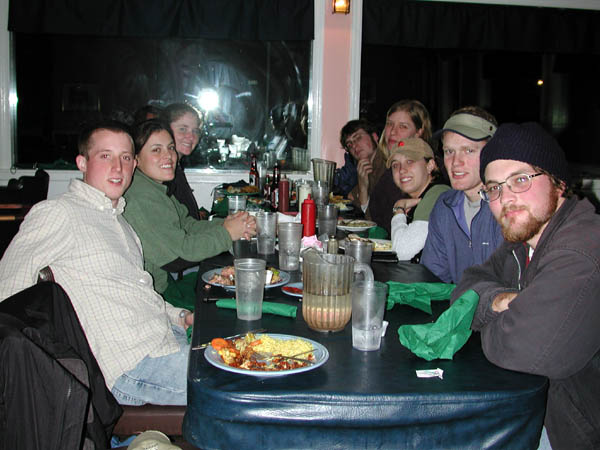
Relaxing at dinner after the beach walk.
The weather on Edisto Island was much more pleasant than expected. Rain
was in the forecast for most of the day on Thursday, but the day passed
with only a few raindrops. In the early morning the sky was blanketed
in low clouds that looked as if they would release a heavy rain at any
moment. The temperatures started out relatively cool, probably in the
40s, causing some of us to bundle up before beginning our walk on the
beach. After an exciting breakfast at the Piggly Wiggly we made our way
onto the beach to begin our walk. By this time, around 9:30am, the temperature
had warmed up and the clouds were beginning to clear.
On the beach the tide was between high and low tide, and was receding.
The tidal range was estimated to be approximately 32 yards. Near our
entrance to the beach the first evidence of the beach retreating landward
was observed.
The trunks of dead palmetto trees, which are usually present in the back
dune environment, were seen protruding from the sand of the beach. The
sand on the beach consisted predominately of fine-grained quarts and shell
fragments, with a small proportion of darker heavy minerals. All of the
grains appeared well-rounded.
While walking north up the beach we recorded observations in our notebooks
about beach processes.
These included the long shore current direction, hightide line, cuspate
berm, rills, and sketches of bedding along cuts into the berm. Along the
majority of the beach there was an absence of a well-developed dune system,
and from the top of the beach one was able to see the marsh. From this
vantage point we observed further evidence for beach migration. Washover
fans, which are fans of sand deposited from the beach onto the marsh during
a storm, showed that the beach is undergoing landward migration.
We encountered many sedimentary and stratigraphically significant occurrences
on our beach walk.
For example an eroded dune gave us a peek at the past by exposing three
parallel beds. By looking at these beds, composed of two shell layers
and one thick sand layer, we were able to interpret the depositional process.
We also came upon an old oyster mound in the beach sand, which told us
that the beach is migrating landward.
By taking shallow cores near the oyster mounds, we learned that there
was a thick very well sorted clay layer directly below the beach sand.
This very sharp contact between sandstone and shale is present in ancient
rock records and it was helpful to see it in modern environments to understand
how such a contact can exist.
The tidal creek outlet and corresponding ebb tidal delta provided a look at fluvial processes as well as beach processes. Meanders (bends) in the tidal creek created a point bar in the inside of a meander where active sediment deposition occurred. The outside of meanders had been eroded into cut bank features, exposing the extremely fine-grained marsh mud over which beach sands had migrated. Standing on one of these cut banks, we had a look at cross bedding in dune structures. The cross beds dipped landward at a very shallow (5 degrees or so) angle.
Further up the tidal creek, a view of the dunes from the back made apparent
the extent of sediment washover fans.
A great deal of Spartina marsh grass had been nearly covered by washover sands. Spartina only grows in the tidally influenced muddy marsh areas, and the presence of sand obscuring the grass indicates a beach moving landward. The outlet of the tidal creek was a point at which regression (seaward movement) of the beach was occurring. Large sand waves (dunes) of sediment had been deposited at the point where the creek met the ocean water and lost much of its energy, leading to deposition of sediment.
The ebb tidal delta created was parabolic in shape, widening towards the ocean. It extended into the ocean beyond the rest of the beach. Three channels were present, but only one was active upon our observation. Significant transportation of sediment on the bed of the creek was clearly visible, but velocity was too high to create any clear bedforms in the sediment. In areas where the creek had flowed that were now exposed by the receding tide, numerous ripple marks could be observed.
Wave oscillation ripples, identifiable by long, sinuous crests, graded into 3-D current ripples, with short, curved crests. Interference ripples with no clear crest scheme denoted grading between the two types. The sediments deposited into the ocean by the tidal creek were rich in fossils, and many types of fossils could be found in the large sand waves of the delta. Those who braved the chilly water in the tidal creek recovered numerous ray teeth and shark teeth.
After a revitalizing lunch, which consisted of large quantities of peanut butter for most of the students, we decided to head back down the beach towards our campsite. Along the way we re-observed the previously mentioned features in hopes to understand them more fully and thus be able to draw an accurate map of the area upon returning to Furman. We were also fortunate enough to witness ripple migration as a small channel of water emptied back into the ocean.
Edisto Island provided an excellent atmosphere for all of our fieldwork. Being able to view actual images of what we had learned about in class helped us fully understand the intricacies of the beach zone. The beach walk allowed us to experience what we had only known through books, before we went on the field trip.